What We DO
Uninexus provides a framework that links the physical and digital worlds through our UniEdge platform and Bifrost base station. By combining field data, access management, and governance with advanced functions such as target acquisition, adaptation, and service delivery, we enable organizations to improve efficiency, ensure secure interactions, and deliver responsive services in real time.
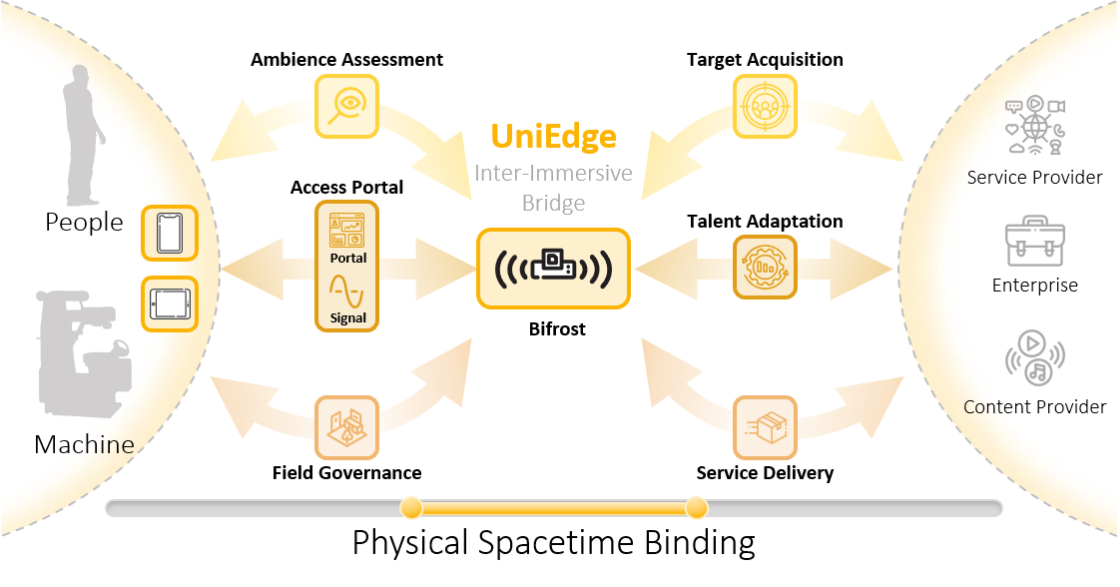
Ambience Assessment
Gives Bifrost all the field information it needs to provide the best services and experience.
Access Portal
Divided into two segments, providing access to humans and machines as well as different data and communication streams.
Field Governance
Allows Bifrost to interact with the environment to follow specific protocols or actions based on unique situations.
Target Acquisition
Gives Bifrost all the field information it needs to provide the best services and experience.
Talent Adaptation
Talents will adjust and dynamically modify to remain effective in that exact spacetime, improving overall experience and productivity.
Service Delivery
Pushes content and applications closer to users, ensuring faster access, lower latency, and more reliable service availability.
Why You Need It
Reliable Data, Smarter Outcomes
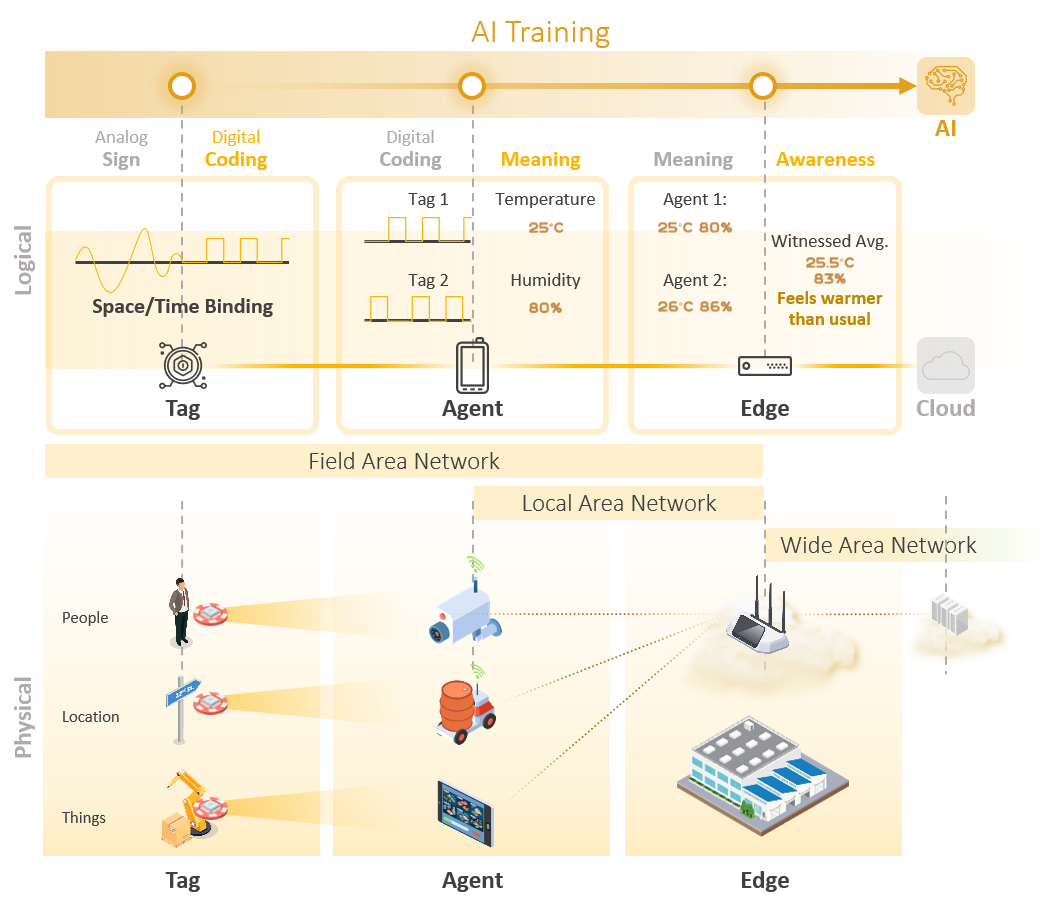
Accurate AI and automation depend on consistent, high-quality data. By combining Tags, Agents, and Edges, Uninexus ensures seamless acquisition of real-world information with no interference or loss. This creates a trusted foundation for reliable, scalable, and high-performing AI outcomes.
For AI systems to deliver meaningful insights, they require not just data, but context-rich and validated information. Our architecture ensures that signals captured in the field are transformed into actionable intelligence, enabling faster decisions, improved resilience, and scalable performance.
How It Works
System Architecture
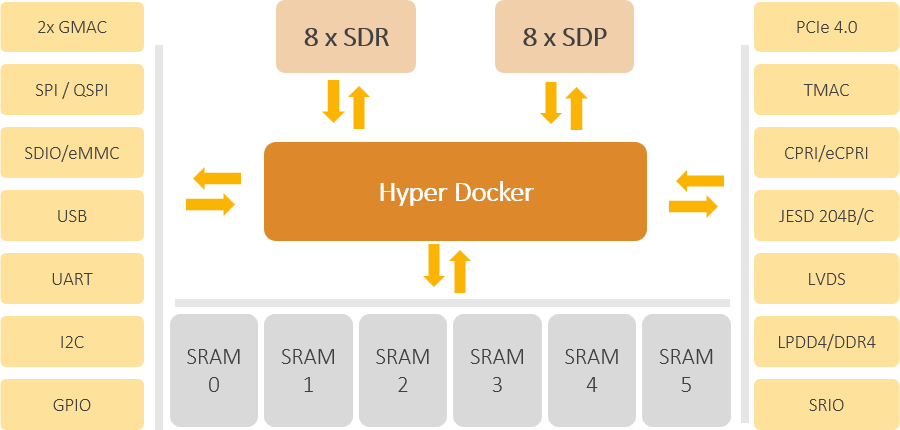
At the core is the Hyper Docker engine, integrating 8 SDR (Software Defined Radio) cores for Layer 1 processing and 8 SDP (Software Defined Processor) cores for Layer 2+ tasks. This modular design supports advanced protocols and ensures scalable performance for diverse deployment scenarios.
The system interfaces with a wide range of high-speed and low-latency connections, including PCIe 4.0, CPRI/eCPRI, SRIO, TMAC, JESD204B/C, and LPDDR4/DDR4 memory. Additional I/O such as USB, UART, I²C, and GPIO enable integration with external devices, sensors, and legacy systems.
Key Capabilities
- Full-stack 4G/5G small cell SoC with support for L1/L2/L9.
- Flexible support for FDD/TDD modes, 2x 4T4R 100 MHz 5G cells, and dual-mode 4G/5G operation.
- Compact 12nm process design with low power consumption (≤2W).
- Optimized packet processing, synchronization, and security through DPDK/IPsec and SyncE.
- Hardware accelerators for coding, integrity protection, and advanced protocol handling.
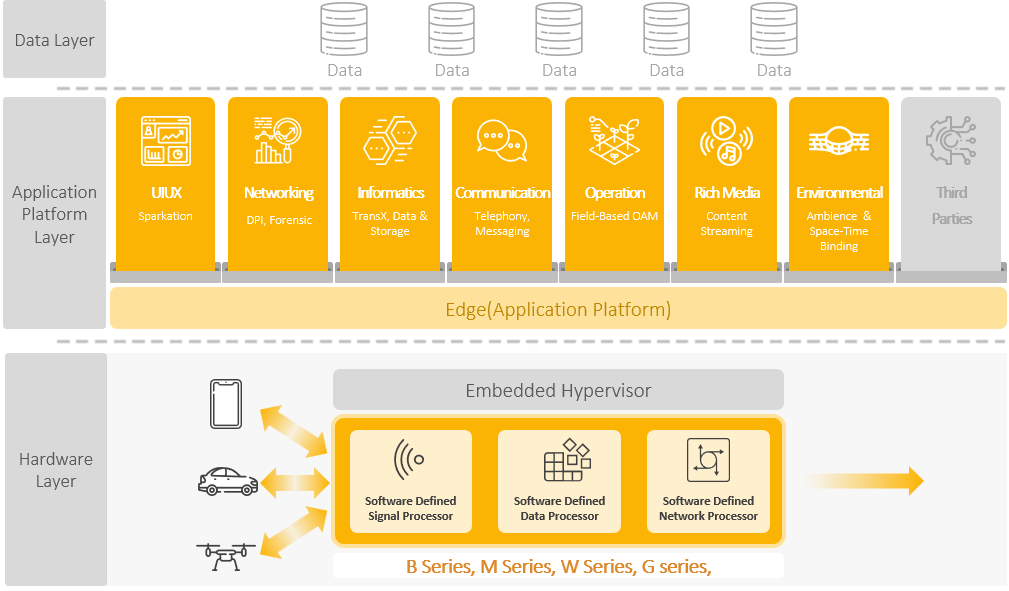
Edge Intelligence
Enables advanced data collection, real-time analytics, and localized machine learning—driving instant insights and automated actions for applications like predictive maintenance or autonomous operations. Through an embedded hypervisor, UniEdge platforms integrate three software-defined layers:
- Signal Processing – transforms raw input into structured data.
- Data Processing – applies real-time analytics and localized machine learning.
- Network Processing – manages adaptive connectivity and ensures deterministic performance.
This layered approach enables instant insights, real-time responsiveness, and autonomous decision-making across field, local, and wide-area networks.
Application Platform
On top of the hardware, the Edge Application Platform allows to deliver personalized content and services based on user context and location, enhancing customer engagement and satisfaction. It also unifies multiple functions:
- UI/UX and networking
- Informatics and data storage
- Communication and field-based OAM
- Rich media streaming
- Environmental awareness and monitoring